![iconos [Recovered]-26](https://www.jki.net/hs-fs/hubfs/NewWebpageDesign/Clients/iconos%20%5BRecovered%5D-26.png?width=46&name=iconos%20%5BRecovered%5D-26.png)
Challenge
Delivered production-grade flow cytometry software with real-time nanosecond processing across FPGA, GPU, and PXI hardware achieving orders-of-magnitude performance gains without sacrificing accuracy.
![iconos [Recovered]-27](https://www.jki.net/hs-fs/hubfs/NewWebpageDesign/Clients/iconos%20%5BRecovered%5D-27.png?width=46&name=iconos%20%5BRecovered%5D-27.png)
Solution
A scalable, hardware-accelerated architecture built in custom LabVIEW, combining FPGA real-time acquisition with NVIDIA GPU signal processing and an integrated framework for instrument control, analysis, and visualization delivering production reliability with future platform flexibility.
![iconos [Recovered]-28](https://www.jki.net/hs-fs/hubfs/NewWebpageDesign/Clients/iconos%20%5BRecovered%5D-28.png?width=46&height=46&name=iconos%20%5BRecovered%5D-28.png)
Impact
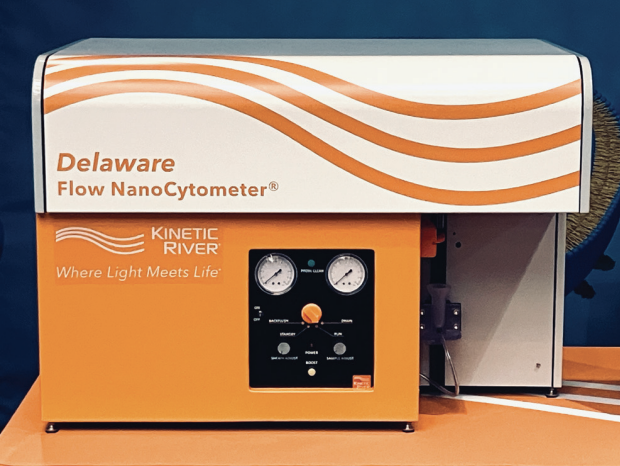
Reduced processing from overnight batch analysis to real time, achieving up to 1,000 events per second and enabling commercialization of the Delaware Flow NanoCytometer.
“We went from overnight processing to real-time. JKI helped us achieve orders-of-magnitude improvement in processing speed.”

Real-World Impact: Detecting Disease Earlier
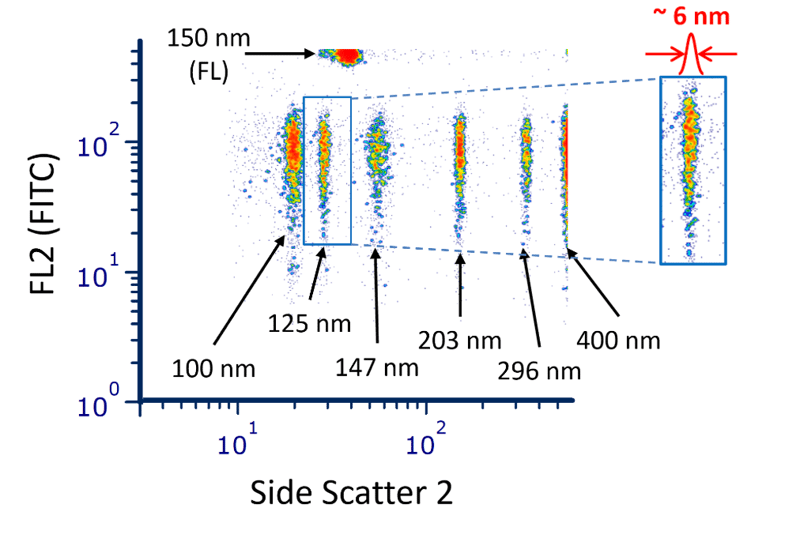
The Delaware's capabilities are already enabling breakthrough research. Professor Chris Ward at the University of Kansas has been using the system for over two years to study polycystic kidney disease, a genetic condition that can be lethal in its later stages.
By analyzing tiny EVs exuded by kidney cells in urine samples, researchers can now distinguish between healthy individuals and those with the disease, potentially years before symptoms appear. "By simply taking a sample of urine, which is easy to get and non-invasive, and analyzing it with minimal processing on our Delaware, you can actually see the difference, quantitatively" Vacca notes.
This approach exemplifies how the Delaware opens new possibilities: using these tiny particles as proxies for internal organs that would otherwise be inaccessible.
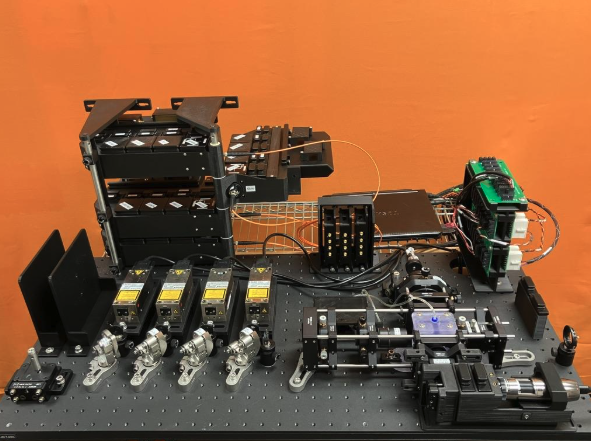
The Arno: A Reinvention of Flow Cytometry
While the Delaware excels at nanoparticle analysis, the Arno represents something even more ambitious: a complete reinvention of flow cytometry principles using time-resolved measurements.
Traditional flow cytometers use continuous laser excitation and measure the steady-state fluorescence of particles. The Arno instead uses extremely short laser pulses, tens of nanoseconds, and captures the fluorescence decay that follows each pulse. This decay, measured at nanosecond timescales, reveals the fluorescence lifetime of each fluorophore.
"Fluorescence lifetime imaging has been used in microscopy for many years," explains Vacca. "We took that idea and applied it to flow cytometry, where it's a thousand times harder to do because the sample is gone the moment you look at it, just a few microseconds, and that's it."
The implications are profound. Two fluorophores with identical emission spectra but different fluorescence lifetimes, say, 4 nanoseconds versus 10 nanoseconds, appear identical to every flow cytometer on the market except the Arno.'
"Those two fluorophores are indistinguishable by any commercial flow cytometer except our own," says Vacca. "A single detector can detect both emissions at once and distinguish them. That's something no other flow cytometer on the market today is able to do."
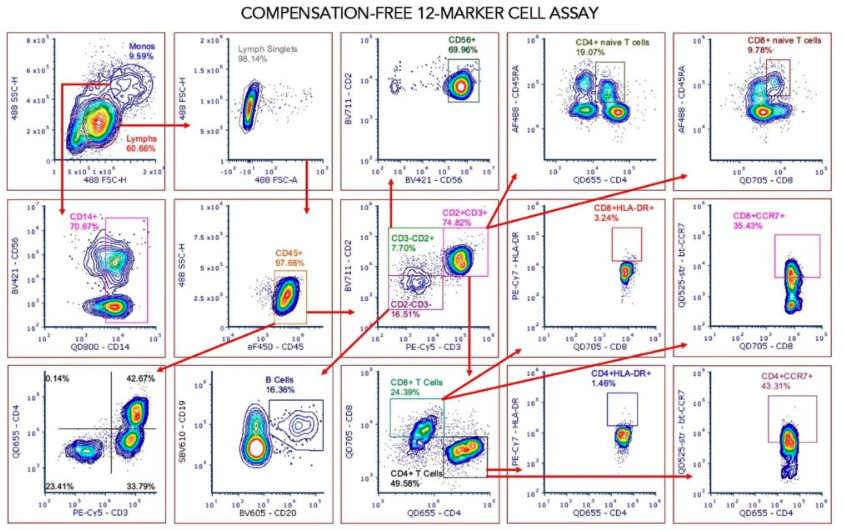
The Promise of Compensation-Free Flow Cytometry
One of the most compelling applications of time-resolved flow cytometry is the elimination of compensation—a burdensome requirement that costs major research facilities millions of dollars annually in reagents and operator time.
In conventional flow cytometry, spectral spillover causes fluorescent signals to spread into multiple detection channels, requiring a complex mathematical correction called compensation. This process demands specialty control materials, repeated calibration for each experiment panel, and significant computational overhead.
"For some high-end labs, it's literally millions of dollars a year in reagents just to do compensation," Vacca notes. "Operators have to constantly buy compensation controls, use up expensive antibody reagents, collect compensation data, apply the corrections to their data, and redo this for every different reagent panel." Even spectral flow cytometry, a modern evolution of the technology that offers finer slicing of the fluorescence spectrum and the ability to analyze more fluorophores simultaneously, must perform the same kind of spectral compensation (called “unmixing”), with even heavier burdens in terms of costs and complexity.
The Arno's compensation-free approach uses widely separated spectral channels combined with lifetime differentiation to provide inherently clean measurements. "Users don't have to worry about that," says Vacca. "They just run the system. That makes it much easier to run, much cheaper to run, and inherently more robust."
JKI's Role: From Seconds to Microseconds
The technical challenges facing both platforms spanned optical, electronic, fluidic, and algorithmic domains. But the most demanding challenge was software: transforming Vacca's working algorithms into production-ready code capable of real-time performance.
"The algorithms I developed went through a lot of iterations, and we were able to hone them quite well already, but they weren't fast enough," Vacca recalls. "It took us sometimes overnight to take the results from one experiment and reduce them to something a cytometrist could use."
Kinetic River's TRFC technology is implemented on a PXI platform with custom LabVIEW code and advanced signal processing algorithms. The architecture distributes processing across specialized hardware: the FPGA handles front-end signal conditioning and high bandwidth, low-latency I/O, while the GPU performs parallel processing on datasets too large or complex for the FPGA alone, and faster than a CPU could manage. Offloading these tasks allows the CPU to focus on core application tasks such as data logging and user interface control.
JKI tackled this challenge in two phases: first accelerating the algorithms in software, then implementing hardware acceleration using FPGAs and NVIDIA GPUs.
"Most of the time, the JKI team knew exactly how to do what we needed. And if they didn't know, they knew exactly where to look to find out." Giacomo Vacca, Kinetic River founder and president
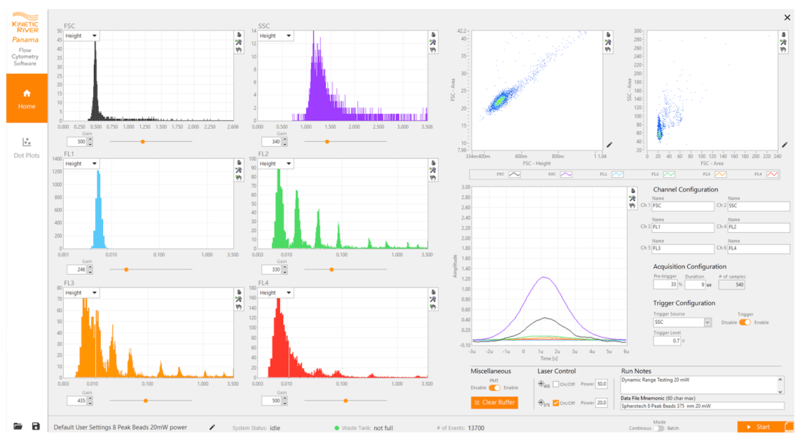
The results were dramatic. By combining GPU and FPGA components in a Real-Time system, Kinetic River's Time-Resolved Flow Cytometer can now characterize thousands of cells per second. The system acquires and analyzes time-resolved flow cytometry data in real time at up to 1,000 events per second, comparable to conventional instruments, while processing an underlying data stream captured at gigahertz speeds. This gives experimenters real-time feedback on their experiment and eliminates the need to store large datasets or wait until post-processing delivers results.
"We went from overnight processing to real-time," says Vacca. "JKI helped us achieve orders of magnitude improvement in processing speed."
Download the PDF to print it and share it with your colleagues.
Nanoparticle Analysis and Time-Resolved Flow Cytometry

Microscope and Fluidics Control with Automated Cell Tracking for Live Cell Assays
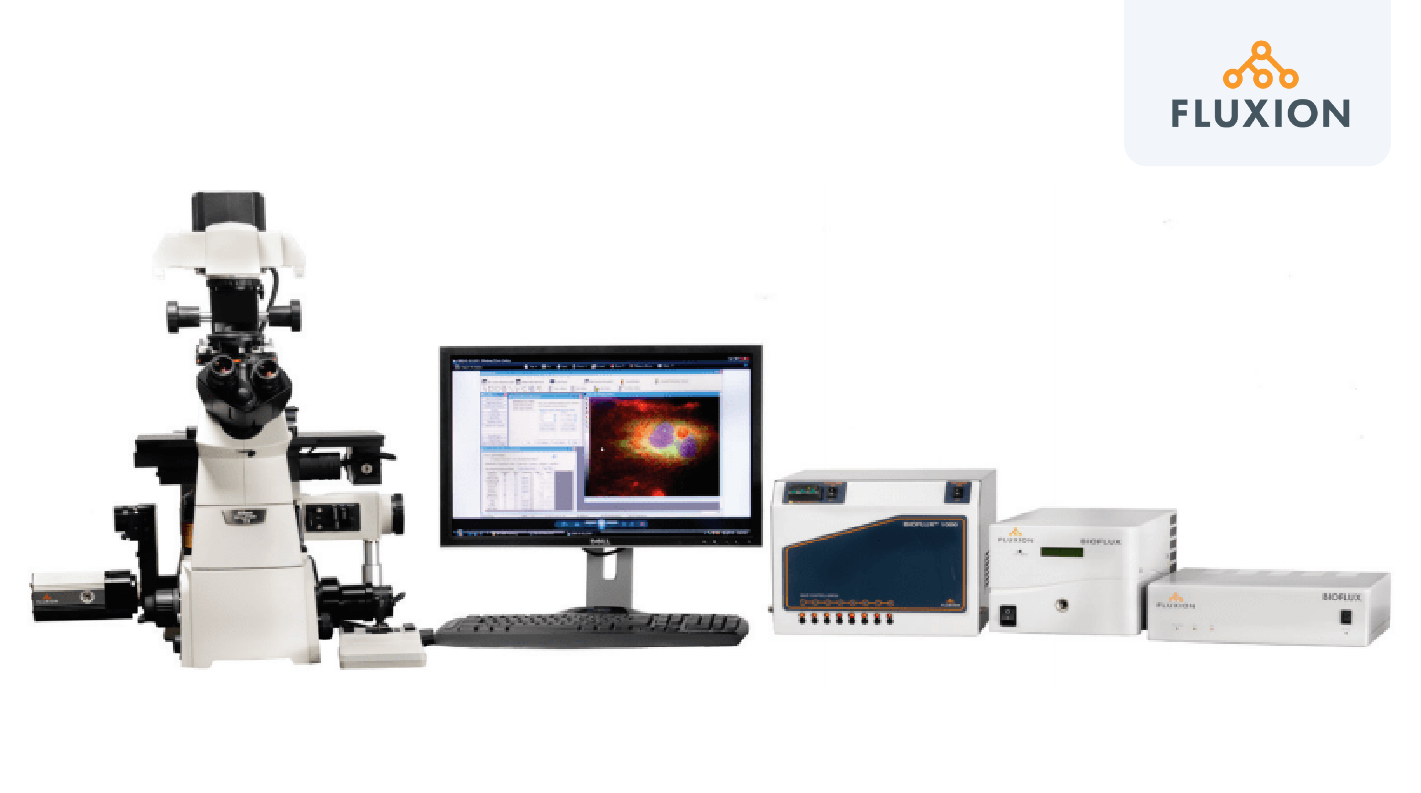
Fluxion Biosciences provides cellular analysis tools for use in critical life science, drug discovery and diagnostic applications. Their systems are designed to replace laborious and difficult assays by providing intuitive, easy-to-use instruments for cell-based analysis. Fluxion BioSciences connected with JKI to quickly and cost-effectively create a software solution to control a new system, which measured real-time behavior and characteristics of live cells when subjected to controlled flow conditions.